

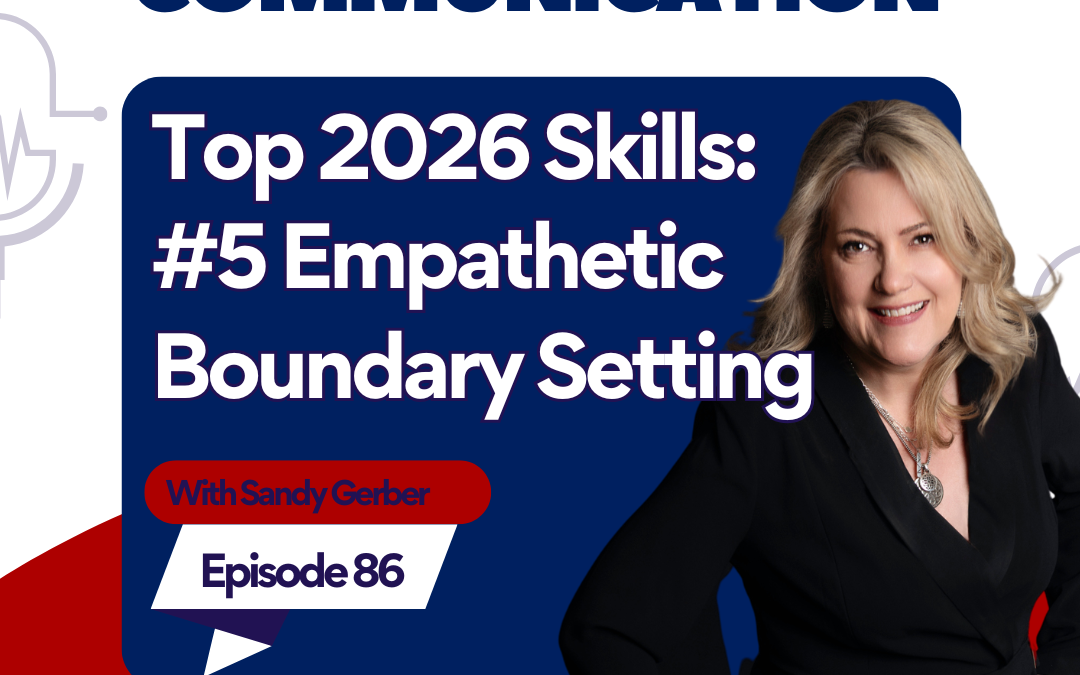
Empathic boundary setting is one of the most important communication skills people will need in the years ahead. In Episode 86 of the Magnetic Communication Podcast, Sandy Gerber continues her series “The Top 5 Human Skills Needed in 2026” by exploring how we can communicate our needs clearly while still maintaining trust, respect, and connection with others. This five-episode series looks at the human communication skills that matter most in a world where conversations carry more pressure than they used to. Workplaces are evolving quickly, relationships are navigating constant digital noise, and emotional tolerance windows are shrinking. The ability to communicate clearly, calmly, and constructively is no longer optional. It is essential.
The Five Human Skills Covered in This Series
This series explores five practical communication abilities that help people navigate modern conversations more effectively.
The series began with emotional self-regulation, the ability to steady yourself before reacting in conversation so you can respond thoughtfully instead of impulsively.
The second episode explored emotionally intelligent communication, the skill of choosing words that move conversations forward rather than escalate tension.
The third episode focused on asking Honest Questions, a powerful way to deepen connection by inviting people into real dialogue instead of surface-level conversation.
The fourth episode addressed conflict mitigation, the ability to slow tension in difficult conversations and keep discussions productive rather than reactive.
In this final episode, Sandy turns to empathic boundary setting, a skill that brings all four of the earlier abilities together.
Why Empathy Alone Can Create Hidden Frustration
Many people believe strong communication means being endlessly understanding.
They try to see the other person’s perspective, listen carefully, and keep conversations calm. Empathy is an important foundation for connection, but empathy alone can create a hidden problem.
When people consistently prioritize understanding others without expressing their own needs, tension quietly builds.
Over time that tension often shows up as frustration, avoidance, or sudden emotional reactions that seem to come out of nowhere.
A Better Middle Path for Difficult Conversations
Empathic boundary setting creates a middle path.
It helps people acknowledge what the other person may be experiencing while also expressing how a situation affects them.
This balance keeps conversations grounded and focused on moving forward rather than assigning blame.
Throughout the episode, Sandy shares relatable stories and everyday examples that illustrate how small shifts in communication can transform difficult conversations.
When people learn to express their needs with clarity and respect, misunderstandings decrease, trust grows, and collaboration becomes easier.
The Real Skill: Empathy and Honesty Together
As the series “The Top 5 Human Skills Needed in 2026” concludes, this episode highlights an important truth.
Communication is not about choosing between empathy and honesty.
The real skill is learning how to bring both into the same conversation.
Empathic boundary setting allows people to protect their own wellbeing while strengthening the relationships that matter most.